The Softening
The questioning isn't the crisis. The questioning is the curriculum.

The ego isn't a villain.
For the first half of life, it's essential—the part of you that builds, proves, establishes. I am this, not that. I belong here. I matter because I achieved this. The ego differentiates you from the undifferentiated mass. It carves out a self where there was only potential.
You can't give away a self you never built. The ego builds it.
But somewhere in the middle of life, the urgency shifts.
The achievements still come, but they satisfy less. The validations arrive, but they don't land the way they used to. You're still building, still proving—but the urgency has a hollow ring. You catch yourself wondering: building what? For whom? And why does this matter less than it used to?
We have one story about this moment: crisis. Something broke. You're having a breakdown. Buy a sports car, make regrettable decisions, hopefully recover.
But James Hollis calls it something else: the Middle Passage. Not a breakdown—a crossing. The ego's urgency isn't failing. It's completing.
Here's the arc:
Building. The first phase. Ego-forward, accumulating credentials and relationships and identity markers. Necessary work—you need a self before you can ask what the self is for. The question driving this phase: Am I enough?
Questioning. The middle phase. The accumulated markers stop answering the question. The validations that used to settle the anxiety now barely register. You've proven what you set out to prove, and the proving didn't resolve what you thought it would. A new question emerges: Is this all there is?
Softening. The later phase. Not giving up—releasing. The grip loosens, not from defeat but from maturation. The ego that demanded external validation begins to quiet. Not because you've finally proven enough, but because the question stops feeling urgent.
This isn't decline. It's development.
Carl Jung observed that creativity in the second half of life has a different quality. It becomes integrative—pulling together everything you've been into something that couldn't have existed when you were still building the pieces. The young artist proves themselves. The mature artist disappears into the work.
Bertrand Russell, writing on growing old, observed that the self naturally widens as it ages. The boundaries that once felt essential—my achievements, my identity, my legacy—become less important. Not because you've failed to maintain them, but because you've outgrown the need to.
The ego softens because it's supposed to. That's what maturation looks like.
Feel this in your body.
The ego-urgency phase: chest forward, always proving, a low hum of am I enough? running beneath every achievement. Even rest carries a subtle tension—you're not doing enough, being enough.
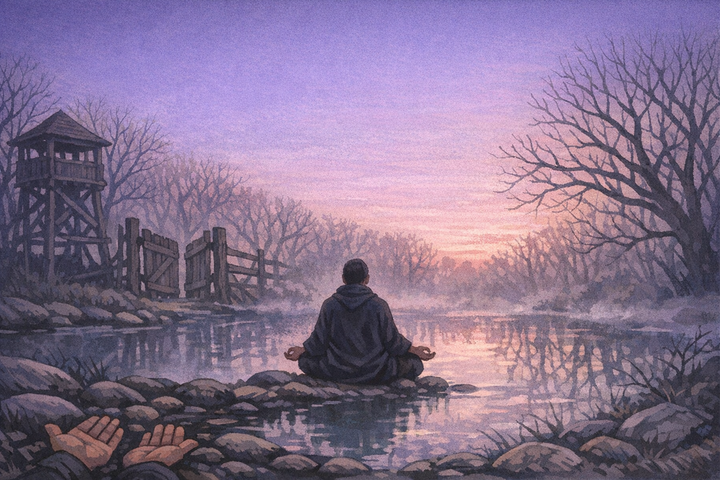
The softening: the hum quiets. Your shoulders drop. There's nothing to prove in this moment, and the nothing-to-prove doesn't feel like failure. It feels like arrival.
You're not less. You're just less concerned with being more.
The danger is mistaking the softening for decline.
If your only model is the upward arc—more achievement, more recognition, more building—then any reduction feels like loss. You fight to maintain the urgency. You treat the questioning like something's wrong. You treat a developmental transition like a disease to cure.
But the questioning isn't the crisis. The questioning is the curriculum.
What you're being asked to release isn't your value. It's your death grip on proving it.
Inner alignment in the second half of life isn't about building a better ego. It's about letting the one you have find its proper size.
The ego served you. It built the container. Now the question is different: What is the container for?
The first half of life asks: Who am I? The second half asks: Now that I know who I am—what wants to come through?
You don't answer this question by building harder. You answer it by softening enough to hear what's been waiting beneath the noise of your own proving.
What would it mean to let the urgency quiet—not because you've failed, but because you've arrived at the phase where urgency isn't what's needed?
Sources: James Hollis, Bertrand Russell, and Carl Jung via The Marginalian