The Machine That Forgot to Feel
Darwin's mind became a machine for grinding facts — and the capacity for beauty went silent. What you don't practice, you lose.
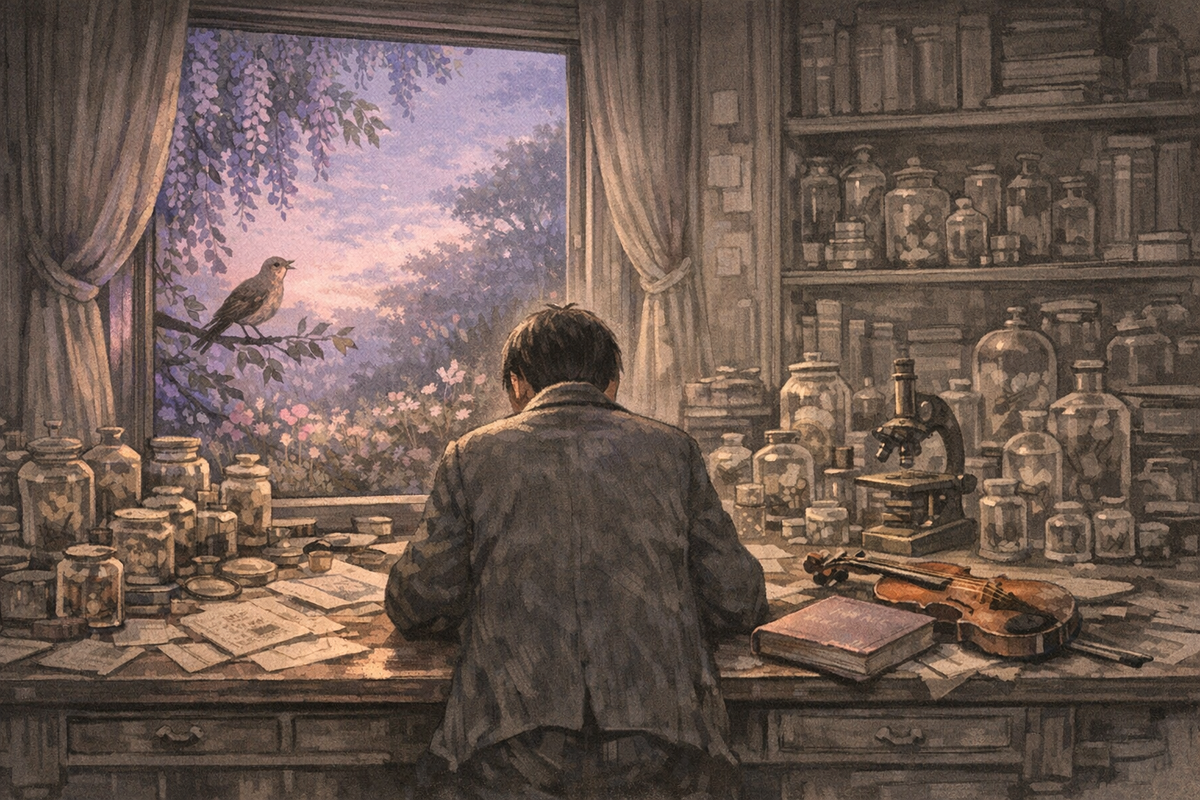
Late in his life, Charles Darwin made a confession that had nothing to do with natural selection.
He had lost the ability to feel beauty.
Poetry, which once moved him deeply, now repelled him. Music, which had given him "very great delight," now only triggered thoughts about work. Fine scenery still registered — dimly, like a signal through static — but the exquisite response was gone. His mind, he wrote, had become "a kind of machine for grinding general laws out of large collections of facts."
The machine had produced On the Origin of Species — arguably the most consequential idea in the history of science. And it had cost him the part of himself that could be moved by a poem.
This is not the story we usually tell about neglecting inner life. That story features burnout, breakdown, the body forcing the reckoning the mind avoided. Darwin didn't burn out. He thrived. The machine ran beautifully. He published, corresponded, observed, theorized — decade after decade of astonishing productivity. Nothing broke.
Something went silent.
And that's the version of misalignment that should keep you up at night. Not the dramatic collapse, but the quiet atrophy. The capacity you didn't notice losing because everything measurable was still working.
Darwin knew exactly what had happened. "The loss of these tastes is a loss of happiness," he wrote, "and may possibly be injurious to the intellect, and more probably to the moral character, by enfeebling the emotional part of our nature." He wasn't being sentimental. He was diagnosing a systems failure — recognizing that the parts of him that responded to beauty weren't decorative. They were load-bearing.
His prescription was heartbreakingly modest: if he could live again, he would read some poetry and listen to some music at least once a week.
Not daily. Not with spiritual discipline. Just once a week. That's how little it would have taken to keep those pathways alive. And he couldn't even manage that — not because he lacked time, but because the machine didn't see the point. The grinding of facts was always more urgent, more measurable, more obviously productive than sitting with a sonnet.
Here is the pattern, and it operates in most of us:
What you attend to, strengthens. What you neglect, atrophies. Not suddenly — gradually, invisibly, while you're busy succeeding at the things you decided matter most. The capacity for beauty is not a permanent installation. It's a practice. Stop practicing and it fades so slowly you don't notice the silence until it's pervasive.
Attention is not a permanent endowment. It's a resource you allocate, and what you starve of it doesn't wait patiently for your return. It thins. The resonance narrows. You can still function at a very high level, but you're functioning on fewer and fewer frequencies.
Darwin's machine-mind was not broken. It was too focused — aligned so completely along one axis that every other axis collapsed. A person who can only vibrate on one frequency isn't aligned. They're narrowed. And narrowing, no matter how productive, is a quiet kind of dying.
Simone de Beauvoir saw the same pattern from the other end. "There is only one solution if old age is not to be an absurd parody of our former life," she wrote, "and that is to go on pursuing ends that give our existence a meaning." But meaning, for de Beauvoir, wasn't the inner-directed kind — not meditation or self-reflection or the examined life. Her antidote was outward-facing: "love, friendship, indignation, compassion." Passions strong enough to prevent us turning in on ourselves.
Notice what she included: indignation. Not just the gentle emotions — love, friendship, compassion — but the fierce one. The one that says this is wrong and I refuse to look away. De Beauvoir understood that staying alive inside isn't only about tenderness. It's about remaining capable of being moved — by beauty, yes, but also by injustice. The person who can no longer feel outrage at cruelty has narrowed just as surely as the one who can no longer hear music. Engagement means the full range, not just the comfortable frequencies.
This is the complement to Darwin's loss. He lost the capacity to receive — to be moved by beauty, by music, by a landscape. De Beauvoir names what must be actively given — engagement with the world that flows outward from you. The two together describe a circuit: beauty comes in, compassion and indignation go out, and the self stays alive at the center.
Break the circuit anywhere and you get a functioning person who has stopped being a full one.
The uncomfortable truth is that alignment and productivity are not the same thing. You can be enormously productive and profoundly misaligned. You can build the most important scientific idea in history and lose the ability to hear music. You can optimize every morning and starve the part of you that doesn't know what optimization is for.
This is the cautionary counter-narrative. That deeper self — the one that hungers for eternity — doesn't wait quietly when you ignore it. It atrophies. And the softening that maturation promises — the ego relaxing its grip, the urgency quieting — doesn't arrive automatically. For Darwin, it never came. The machine ran until the end, and the man inside it grew steadily more narrow.
So here is the question, and it's not rhetorical:
What has gone quiet in you?
Not what have you lost — what has thinned? What used to move you that now barely registers? What capacity have you stopped practicing because the machine doesn't see the point?
Darwin's regret wasn't that he worked too hard. It was that he let one kind of work consume every other kind of attention. The beauty was always there — the poems, the music, the landscapes. He just stopped being the kind of person who could receive them.
Once a week. That's all it would have taken.
What would it cost you to practice, once this week, the thing in you that produces nothing — and might be the most important thing you have?
Sources: The Marginalian — Charles Darwin, Autobiography; Simone de Beauvoir, The Coming of Age